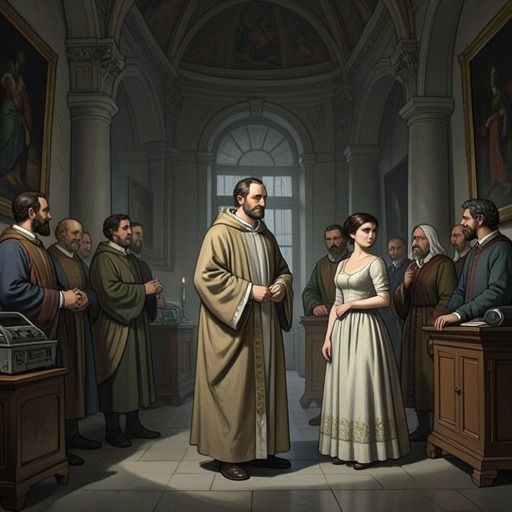
Aravis's Forced Betrothal to Ahoshta
The Horse and His BoyAravis’s Forced Betrothal to Ahoshta is the coercive arrangement that drives Aravis to flee her father’s household. Her father accepts Ahoshta’s proposal under pressure from his wife and in view of Ahoshta’s growing power, while Aravis’s own refusal is excluded from the decision; the prospect leads her to despair and then to a carefully planned escape with Hwin.
Identity and Background
Aravis introduces herself as the daughter of Kidrash Tarkaan, lord of the province of Calavar, and describes a family marked by recent loss: her mother is dead, one brother fell fighting rebels in the far west, and her other brother is still a child. Her stepmother hates her and persuades her father to promise her in marriage. These circumstances place the decision within a household where Aravis has little authority over the plans made for her.
Ahoshta has risen in status through the favor of the Tisroc, whom Aravis’s account describes as having gained confidence through flattery and harmful counsel. He has become a Tarkaan and lord of many cities, and may become Grand Vizier when the current officeholder dies. Aravis also emphasizes the disparity between the powerful prospective groom and herself: he is at least sixty, while she is the young daughter whose future is being negotiated by others.
The Arrangement and Aravis’s Response
Aravis’s father sends messengers to offer her in marriage, and Ahoshta accepts. The marriage is planned for that same year, at high summer. Her father’s decision is explained by Ahoshta’s wealth and power as well as by the stepmother’s persuasion; the account gives no indication that Aravis is consulted or agrees.
When the news reaches her, Aravis says that she weeps for a day. On the second day, she rises, washes her face, has Hwin saddled, and rides away alone with a sharp dagger once carried by her brother in the western wars. In a secluded wood, she prepares to take her own life, believing death preferable to the future imposed on her. Hwin intervenes and urges her not to die. Aravis’s account makes the betrothal’s immediate consequence unmistakable: it drives her to the brink of self-destruction before her mare’s intervention opens another possibility.
Escape and Significance
After Hwin speaks and tells Aravis about Narnia, the prospect of a country where no maiden is forced to marry against her will gives her a reason to hope. The two agree to leave together. Aravis returns to her father’s house, dresses in her finest clothes, sings and dances, and pretends to welcome the marriage. She asks permission to spend three days in the woods with a maiden, presenting the journey as a customary religious observance before marriage; her father grants it.
Aravis then privately enlists her father’s elderly secretary, who had cared for her since infancy. He weeps and asks her to reconsider, but ultimately helps her by writing a letter at her request. The contrast between the public performance that secures permission and the secret preparations that enable departure shows how Aravis must work within the limited choices available to her. The betrothal is not completed in this episode: it becomes the immediate cause of her flight, while Hwin’s intervention and the prospect of Narnia turn a coerced future into a risky escape.